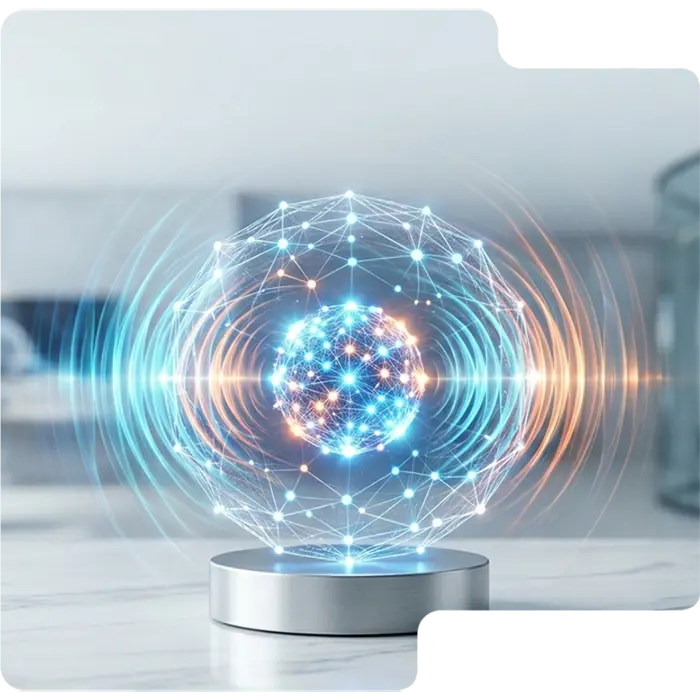
Current models apply identical computation to every token. ARIA's resonant layers iterate until convergent — easy inputs resolve fast, hard inputs think deeper.
Per-layer convergent iteration. 10× smaller than standard FFN with matching quality. Variable depth is intrinsic.
Separate spaces for language, logic, numbers, and code — each using native operations. Math uses real arithmetic.
Selective long-term storage inspired by crystal bonding. Importance driven by resonance difficulty × state change magnitude.
Generates candidates via MC Dropout, verifies before output. Code is executed. Math is computed. Facts are checked.
Small 2–3B model always in VRAM + 300GB–1TB expert library loaded phase-sequentially from SSD.
AI data centers cost billions. Meanwhile, millions of machines sit idle. Aether creates a secure P2P network where anyone earns by contributing compute — like Uber for processing power.
Users join the secure virtual network and install Aether runtime
Smart scheduler selects nodes by uptime, speed, and GPU capability
AI workloads are distributed, encrypted, and processed across the network
Contributors earn based on verified computation delivered
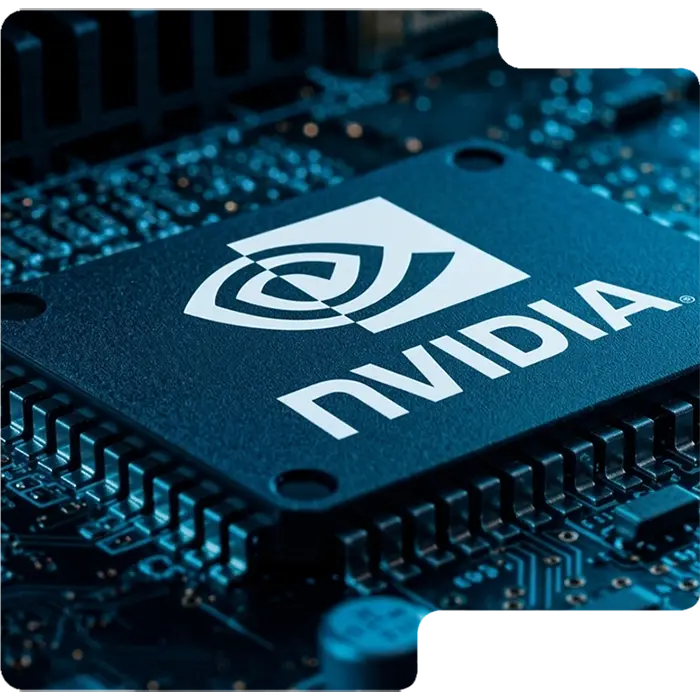
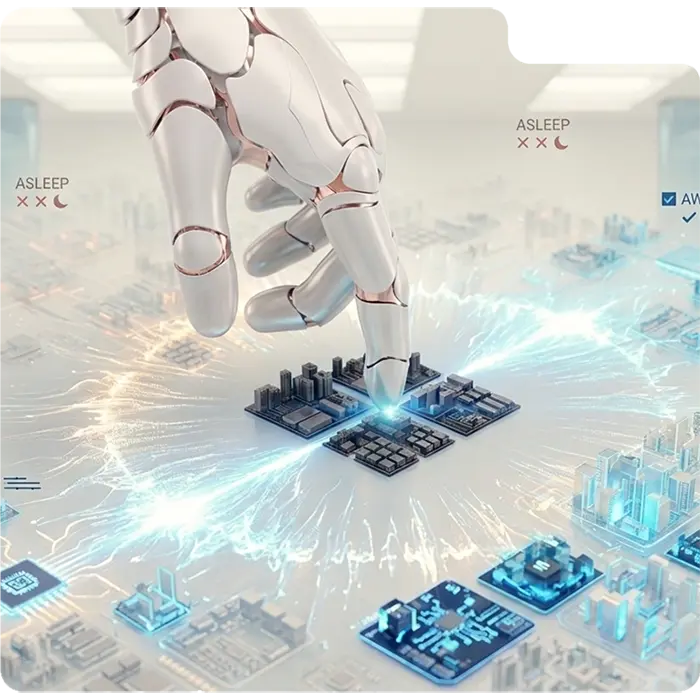
Current GPUs waste 90% of their circuits on operations AI doesn't need. NEXUS is purpose-built for ternary neural operations — no FP multipliers, no HBM, no liquid cooling.
| NVIDIA H100 | NEXUS NPU | |
|---|---|---|
| System Cost | $40,000+ | $1,500 – $2,500 |
| Power Draw | 700W | 35 – 75W |
| Memory | HBM3 ($5,000+) | DDR5 ($200) |
| Cooling | Liquid | Passive / Air |
| 500B Inference | ~450 tok/s | ~450 tok/s |
| Dies / Wafer | ~60 | 350+ |
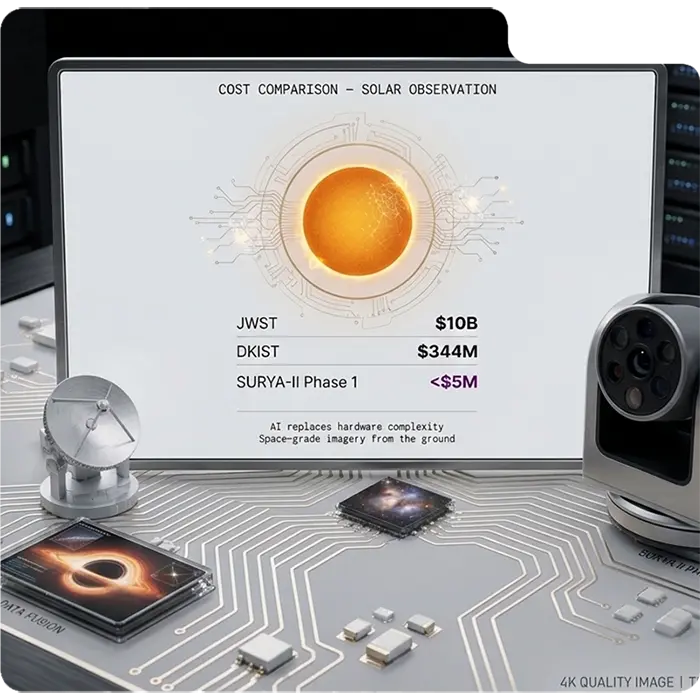
SURYA-II is an AI-native solar telescope that breaks the cost barrier of ground-based observation — delivering space-grade coronal and chromospheric imaging at a fraction of flagship facility costs.
Real-time atmospheric correction using neural networks instead of traditional wavefront sensors — achieving diffraction-limited performance computationally.
AI predicts atmospheric conditions and solar activity to autonomously schedule observations at optimal moments.
Deep learning super-resolution produces imagery rivaling space telescopes from ground-based captures.
Real-time identification of flares, prominences, and CMEs with instant alerts — no human operator required.
Phased deployment: Phase 1 under $5M delivers operational science. Full build remains a fraction of DKIST ($344M) or JWST ($10B).
Vinayagamoorthy
Our CTO spearheads the technological direction of Hattussa IT Solutions with a sharp focus on innovation and scalability. With deep expertise in emerging tech and system architecture, they ensure our solutions are future-ready, secure, and built to perform.
To pioneer a future where intelligent systems are not just tools, but strategic enablers of progress—redefining how organizations innovate, make decisions, and deliver value through deeply integrated, adaptive, and trustworthy AI ecosystems.
To design and deploy robust AI architectures that translate complex data into actionable intelligence, ensuring precision, scalability, and resilience—while fostering continuous innovation, engineering excellence, and measurable impact across every solution we build.

We build custom AI models for classification, prediction, NLP, computer vision, automation, and more—tailored specifically to your business goals.
Yes. Our AI-powered automation solutions streamline repetitive tasks, reduce manual effort, and significantly improve operational efficiency.
Absolutely. We build advanced computer vision systems for object detection, face recognition, anomaly spotting, and quality inspection across industries.
Yes. We create conversational AI platforms using NLP that deliver natural, human-like interactions for customer support, sales, and internal automation.
Our predictive analytics and data intelligence models help you forecast trends, identify patterns, and make accurate, data-driven decisions with confidence.
Combining artificial intelligence, automation, and advanced analytics, we build smart digital solutions that help businesses innovate, optimize, and lead in a rapidly evolving world.